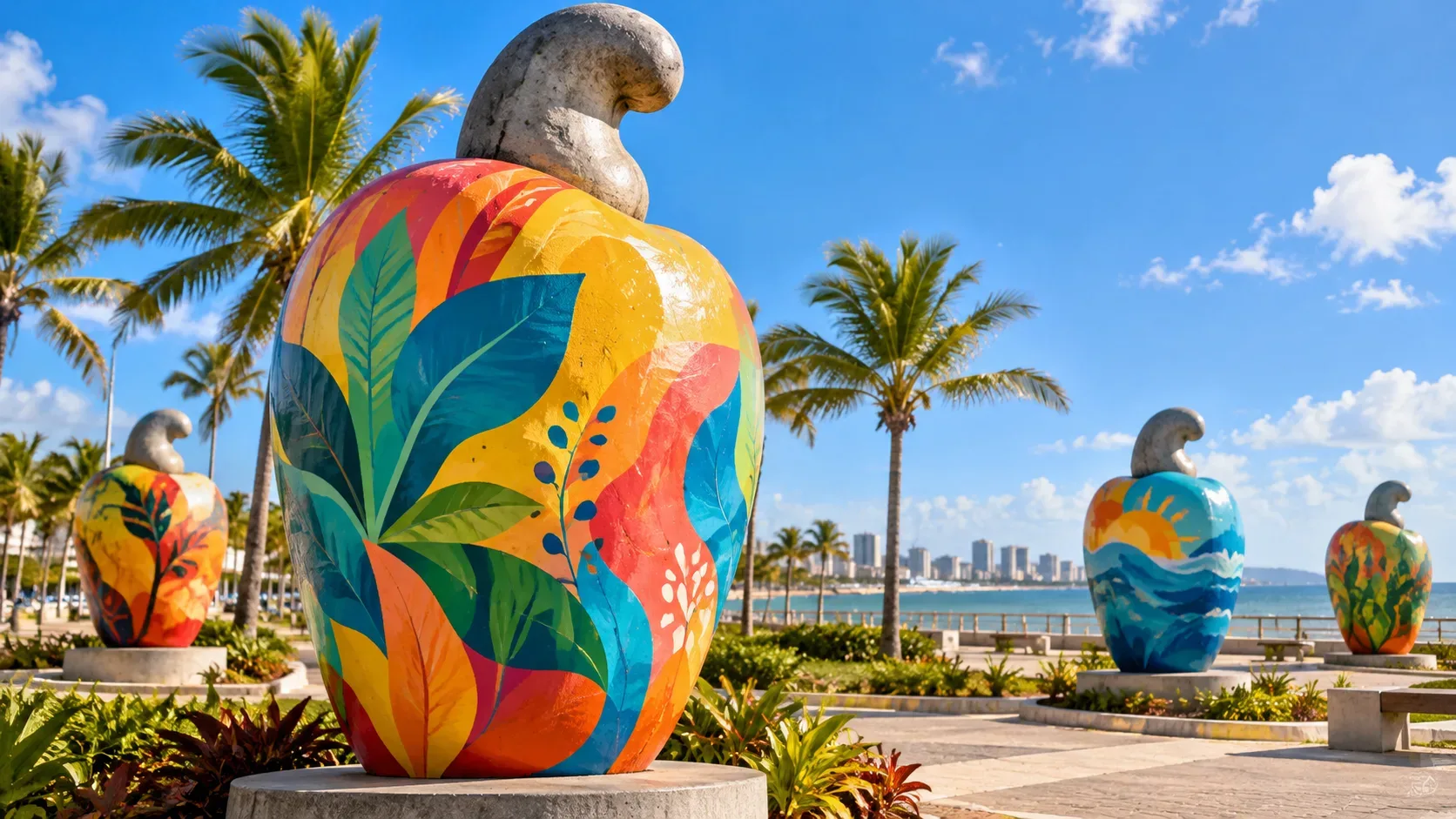
Cajucidade is an urban art project that turns giant cashew-shaped sculptures into canvases for artists in Aracaju, the capital of Sergipe, Brazil. In 2026, the initiative entered its third restoration phase. In an update published on October 24, the city government stated that the collection contains 19 sculptures and that ten had been restored through the current partnership. This does not mean that every sculpture was repainted this year.
What is Cajucidade, and when did it begin?
Conceived by visual artist Fábio Sampaio, Cajucidade uses the cashew fruit as a visual symbol associated with Aracaju. Each sculpture serves as a surface for painting, allowing artists to present different interpretations of the city in public spaces, beyond conventional art galleries.
The Aracaju city government dates the conception of the project to 2009. However, the historical records differ: an Abrasce Awards case study about an initiative at Shopping Jardins describes the movement as having been created in 2010. The sources consulted do not clarify whether those dates refer, respectively, to the concept and to the actual start of activities. Therefore, these records do not establish a single verified opening date for the sculptures.
What changed in the third phase in 2026?
The revival announced by the city government through its Municipal Tourism Department (Setur) involves restoring the sculptures' appearance, involving artists from Sergipe and partnering with private companies. According to the municipal administration, the new phase also introduced collaborative works by pairs and trios, alongside individual interventions.
In August, an announcement published by Jornal da Cidade described plans to decorate 18 giant cashews with work by 32 artists and collectives, supported by Casa das Tintas. That was a plan for the phase, not a list of 18 completed works. On October 24, the municipal update provided a later status report: ten restorations had been carried out within a collection described as containing 19 sculptures, with further work planned gradually.
Which sculptures have confirmed locations and artist credits?
The October 24 municipal announcement names artists and locations for two examples from the third phase:
| Location in Aracaju | Artists identified | What the source confirms |
|---|---|---|
| Mirante da 13 de Julho viewpoint | Guga Juice, also known as Suco | An intervention identified as the first restoration in this phase. |
| Atalaia waterfront, near the J. Inácio Art Gallery | Israel Melo, collaborating with Fábio Sampaio | A restored sculpture incorporating references to the sea, fishing and the local landscape. |
These two credits are not a complete list of the ten restored sculptures. The August announcement also mentioned places such as Colina do Santo Antônio, Orlinha do Bairro Industrial, Parque da Sementeira, Teatro Tobias Barreto, Farol de Aracaju, Orlinha Pôr do Sol, Aruana, Bugio and Praça da Juventude. They were locations named for the initiative, but that report alone does not establish that work was completed at each site.
Why did reports mention 18 cashews in August and 19 in October?
The figures come from announcements issued at different times and referring to different scopes. The August report concerned 18 pieces planned for decoration in the third edition. On October 24, the city government described 19 as the total number of Cajucidade sculptures. Without an itemized municipal inventory showing each sculpture's location, artist and restoration status, there is no basis to conclude that another sculpture was installed between the two announcements, that a counting error occurred or that all 18 planned pieces were completed.
It is equally important to keep the figures separate: 19 is the reported total collection; ten is the number of restorations reported as of October 24, 2026. Subtracting those figures does not by itself identify which sculptures still need attention.
What information is still needed for a complete art route?
For residents and visitors looking for the sculptures, the best-documented locations in this update are Mirante da 13 de Julho and the area near the J. Inácio Gallery in Atalaia. A consolidated public list is still needed to match each of the 19 sculptures to its exact address, artists and restoration status. Locations announced as part of the initiative must not be mistaken for confirmation of completed work.
Information checked against publications available through October 25, 2026. The status of the interventions may change in subsequent phases.