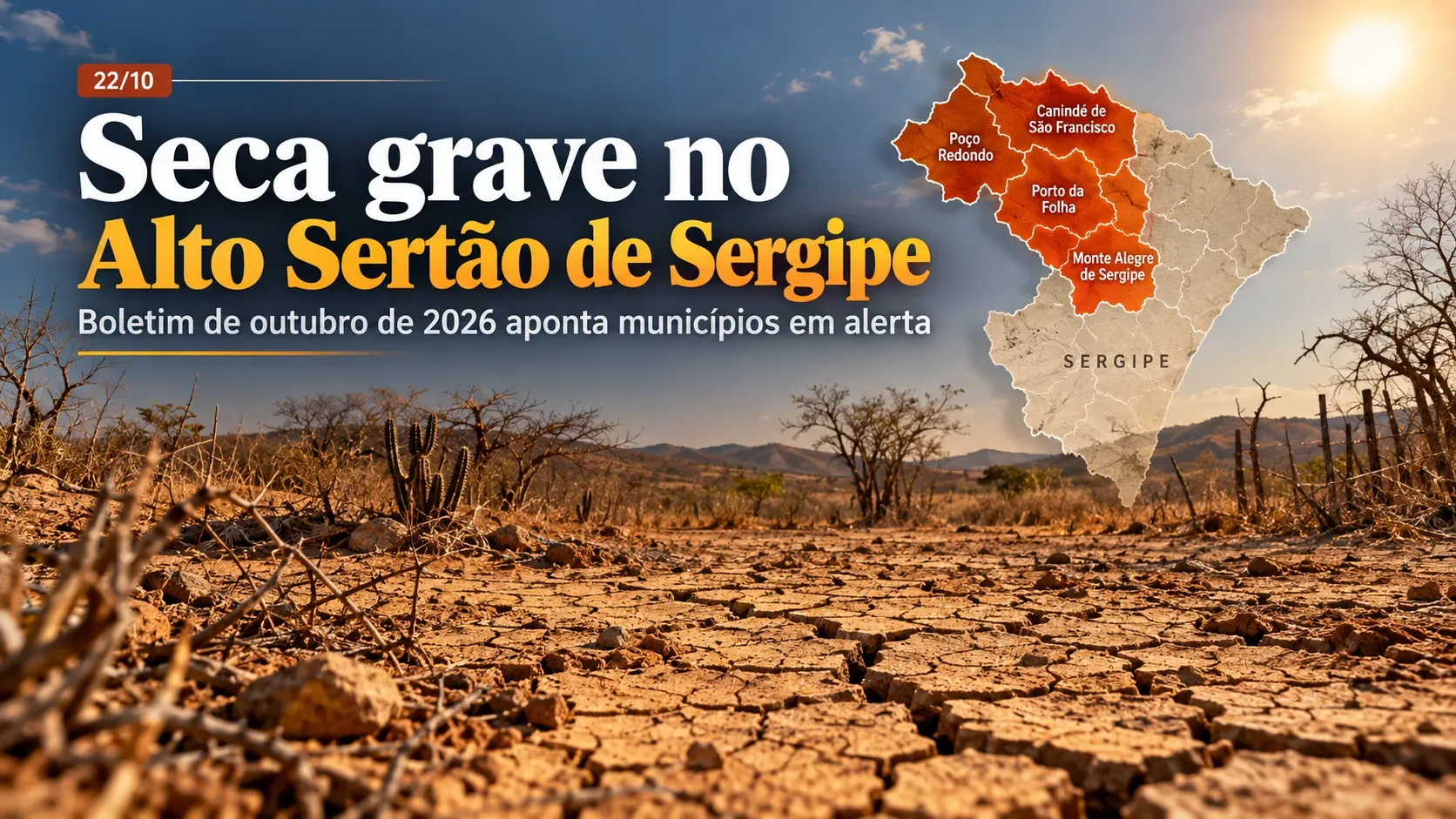
Canindé de São Francisco, Poço Redondo, Porto da Folha and Monte Alegre de Sergipe, in the Alto Sertão of the Brazilian state of Sergipe, were named in the severe drought category announced by the Sergipe state government on October 22, 2026, when it presented the sixth edition of its El Niño Technical Bulletin on Protection and Civil Defense. The announcement alerts residents, rural producers and officials to potential impacts on water availability and farming. It does not, by itself, mean that water rationing is in effect throughout these municipalities.
Which municipalities were named, and at what severity?
The state announcement names the following municipalities as examples of different drought intensities. This is a table of places specifically mentioned in the announcement, not a complete list of Sergipe’s 75 municipalities.
| Municipality | Named territory | Drought classification |
|---|---|---|
| Canindé de São Francisco | Alto Sertão | Severe |
| Poço Redondo | Alto Sertão | Severe |
| Porto da Folha | Alto Sertão | Severe |
| Monte Alegre de Sergipe | Alto Sertão | Severe |
| Nossa Senhora Aparecida | Agreste Central | Moderate |
| Carira | Agreste Central | Moderate |
| Poço Verde | Centro-Sul | Moderate |
| Estância | South | Weak |
| Itabaianinha | South | Weak |
| Umbaúba | South | Weak |
Municipalities omitted from this summary should not be regarded as drought-free. The government says the monitoring covers Sergipe’s eight territories, whereas the table above contains only the ten examples explicitly named in the official news release.
What do weak, moderate and severe drought mean?
These terms distinguish different levels of a climatic phenomenon. As a guide to interpretation, the Brazilian Drought Monitor, associated with the National Water and Basic Sanitation Agency (ANA), treats weak drought as the least intense of its categories, followed by moderate and severe drought. The national scale also includes extreme and exceptional drought. Such gradation helps assess risk; it is not, on its own, an operational notice that water service has stopped.
According to the Drought Monitor’s reference table, potential effects include difficulties for crops and pastureland and reduced water availability in reservoirs, rivers and wells, with greater severity at higher levels. These are risks linked to drought categories, not proof that every consequence is occurring in every municipality. Because the sixth-edition PDF could not be accessed directly during this check, it was not possible to verify whether all of that edition’s technical criteria match the national reference table.
What does the classification say about the water supply?
A severe drought classification does not automatically establish water outages, rotational supply or rationing. The official news release reviewed on October 23, 2026, did not provide a rationing schedule for the four municipalities. To establish whether service has changed on a particular street, in a rural community or in the municipal center, residents need a current, specific notice from the relevant local service provider and Civil Defense authority.
In an announcement issued on October 19, the state Civil Defense agency said that rural communities already affected by water scarcity had been receiving assistance through state operations, and that Alto Sertão was among the areas prioritized for monitoring. This confirms assistance to affected communities, but does not establish that every locality across the four municipalities is without water.
Preventive guidance published by the state
In its announcement of the sixth edition, the Sergipe government reiterated precautions for residents and municipalities:
- Conserve water and avoid waste in daily use.
- Avoid prolonged sun exposure during the hottest periods and pay particular attention to vulnerable people.
- Prevent fires and burning by avoiding practices that could ignite vegetation.
- Register a postal code (CEP) free of charge by SMS to 40199 to receive Civil Defense prevention alerts and safety guidance.
Municipal administrations and local Civil Defense offices are advised to monitor water-supply conditions, share prevention measures and update contingency plans. The reviewed announcement contains no instruction for a general suspension of services across Alto Sertão.
Date, scope and reporting limitations
This article is based on the official announcement dated October 22, 2026, a state Civil Defense statement dated October 19 and the Brazilian Drought Monitor’s public reference table. Sources were checked on October 23, 2026, Sergipe time (UTC-3). The complete sixth-edition PDF could not be opened for direct examination, so the municipality list represents the examples confirmed in the government release rather than an exhaustive classification. Later changes in water service or safety alerts require an updated notice from the responsible authority.