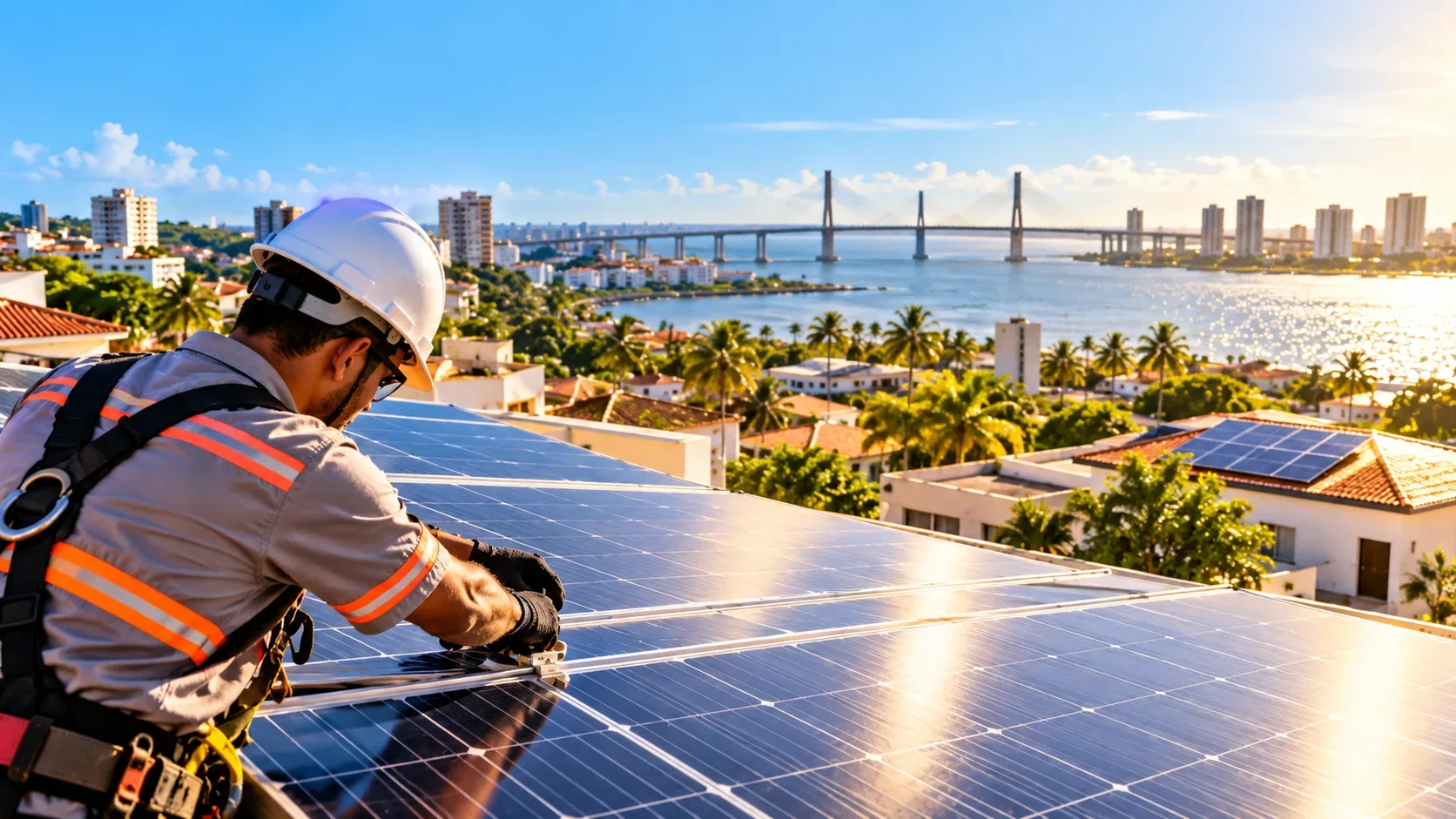
Solar panels can lower electricity expenses for households and businesses in Sergipe, Brazil, but the savings depend on consumption, system cost, electricity-credit rules and, if the purchase is financed, the full cost of the loan. As of October 2026, financing options are described by Banco do Nordeste and Banese. Before signing a contract, compare quotes, identify the distributor serving the property and estimate the net savings realistically achievable.
How to assess whether solar panels are worthwhile
Start by collecting preferably 12 electricity bills rather than sizing a system from the most recent bill alone. Consider consumption in kWh, tariffs, seasonal changes, shade, available roof space and condition, electrical upgrades and estimated monthly generation. A larger system does not always mean a better return, particularly if it creates credits that the customer cannot use.
Request at least three quotes specifying capacity in kWp, expected output in kWh per month and year, named components, installation, engineering, grid-connection arrangements, warranties and maintenance. Compare complete project costs, not simply panel counts. ANEEL states that it does not set equipment prices or financing terms.
Financing in Sergipe: FNE Sol and Banese
| Program | Who may apply | Published terms and limitations |
|---|---|---|
| FNE Sol, Banco do Nordeste | Individuals, businesses and rural producers | Covers equipment and installation. For individuals, the published maximum total term is 8 years and the financing limit is R$ 100,000. For businesses and rural producers, the maximum total term is 12 years. The percentage financed depends on the applicant, location and guarantees; approval is subject to credit assessment. |
| Banese financing for individuals | Individuals who hold a Banese current account | The state services portal describes loans for buying and installing solar systems, with a maximum total term of 72 months and a grace period of up to 12 months. Charges are payable during the grace period. Interest rates vary, while documents and approval depend on the specific transaction and the bank's assessment. |
These are program terms stated on pages checked on October 28, 2026, not approved personalized offers. Obtain written simulations specifying down payment, rate, total effective borrowing cost (CET), charges, insurance if applicable, installments, total repayment and early-settlement conditions. Businesses should confirm eligibility based on size and intended use.
Estimating savings and payback
Compare the expected annual electricity bill without solar with the estimated remaining bill after installation. Subtract maintenance and other recurring expenses from the difference. Compare those net savings with the full price of installation and upgrades, plus interest and related loan charges if financed. A loan installment smaller than expected monthly savings does not, on its own, prove a project will pay off.
Illustration only: an R$ 18,000 project saving a net R$ 250 per month would have a simple payback of about 72 months if those assumptions remained unchanged. This is not a quote or forecast for a Sergipe property. It excludes financing, panel degradation, component replacement and tariff changes. Actual proposals should disclose assumptions and a conservative scenario.
Electricity credits: what the 2026 rules mean
Under Brazil's Electricity Compensation System (SCEE), surplus power fed into the grid may offset consumption, subject to the relevant participation arrangement. Credits expire after 60 months. Local self-consumption, remote self-consumption and shared generation are possible, but credits may be allocated only when regulatory requirements are met, including service by the same distributor where applicable.
For units covered by the transition regime in Article 27, Law No. 14,300/2022 provides for a charge in 2026 equal to 60% of specified distribution-tariff components on compensated electricity. This does not mean 60% of the entire bill, and it cannot automatically be applied to installations protected by the separate Article 26 transitional rules. Ask the project designer to model the tariff treatment applicable to a new installation.
Electricity bills do not necessarily fall to zero. For low-voltage customers, ANEEL describes minimum availability charges equivalent to 30 kWh for single-phase connections, 50 kWh for two-phase connections and 100 kWh for three-phase connections. Group A customers may continue paying for contracted demand. Other bill items and tax treatment require individual assessment.
Connecting through Energisa Sergipe
A grid-connected project requires an engineering submission and a formal application to the distributor serving the property, with applicable documents and regulatory forms. Customers supplied by Energisa Sergipe should check the current process on the Energisa distributed-generation page before proceeding. The full page could not be accessed during this editorial check; approval deadlines and an exhaustive document checklist are therefore not presented as verified.
Energisa does not supply every municipality in Sergipe. According to Agrese, it serves 63 municipalities; Sulgipe supplies municipalities in the south, and a permitted operator supplies settlements around Colônia Treze. Check the distributor named on the electricity bill. A project in Estância, for example, should not be filed with Energisa merely because this guide covers the whole state.
- Confirm the billing account holder and distributor shown on the electricity bill.
- Require a qualified technical professional and an electrical design suited to the property and distributor's rules.
- Request a connection quote and follow the applicable review, installation, inspection and metering steps before treating the system as authorized.
- Keep the design, contract, loan quotation, invoices, warranties and connection records.
Checklist before signing
- Check the total installed cost, with separate equipment, labor, possible upgrades and maintenance costs.
- Request a generation estimate based on local assumptions and a forecast of the residual bill under the applicable tariff rules.
- Compare total borrowing cost using CET, rather than advertised rates or monthly payments alone.
- Check warranties, technical support, connection responsibilities, cancellation terms and payment conditions.
- Reject promises of a zero bill, fixed savings or automatic loan approval.
Commercial contact for a quotation
Voz Sergipana is displaying a partner sales contact provided for commercial referral: Ask for solar-energy guidance and a quotation via WhatsApp. This is a commercial contact, separate from the public-interest information in this guide. The publisher has not verified or guaranteed prices, technical qualifications, sales terms or projected savings; compare other suppliers as well.
Regulatory and financial information checked on October 28, 2026. Loan terms, rates and operational procedures may change and should be reconfirmed before signing.