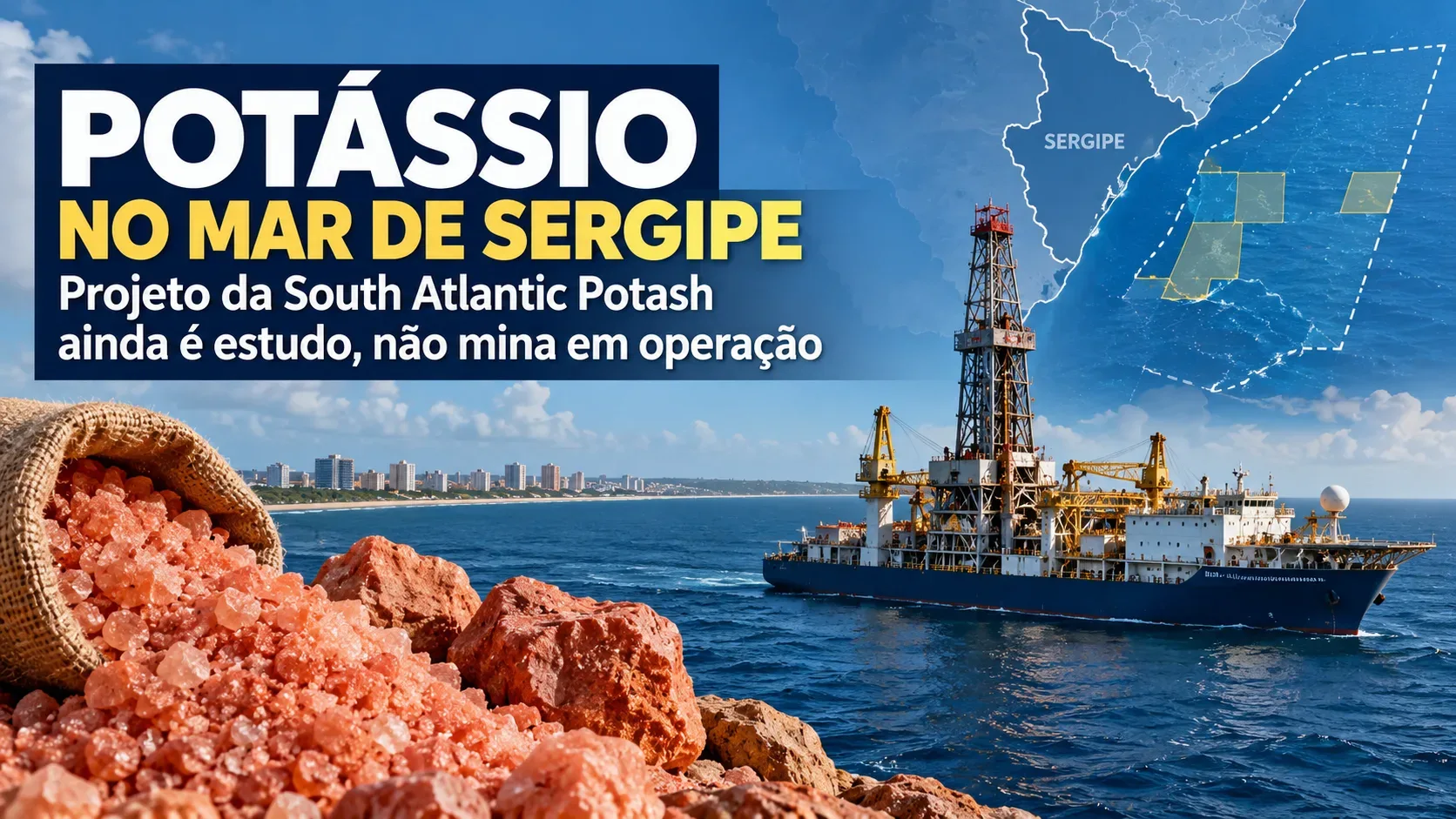
The South Atlantic Potash (SAP) potassium project off the coast of Sergipe, Brazil, is not an operating mine. In its announcement of 27 October 2026, the Sergipe state government said the initiative, in the Sergipe-Alagoas Basin, remained at the conceptual technical assessment stage. Mineral occurrences and research areas have been identified, but confirmation drilling, studies, authorizations and environmental licensing are still needed before any possible offshore commercial production.
What has been identified off Sergipe's coast
According to the state announcement, which attributes the information to Brazil's National Mining Agency (ANM), SAP holds around 189,000 hectares authorized for mineral exploration and has outlined nine sylvinite exploration targets in the Baixo Mosqueiro area. Sylvinite is a rock containing potassium minerals used to manufacture fertilizers. The area described is authorized for mineral research, not for commercial production.
The investigation also draws on historical oil and gas data. According to company information presented in the announcement, four older wells penetrated the geological unit under study and encountered sylvinite. One recorded a 27.5-meter-thick layer approximately 2.5 kilometers below the seabed, in waters described as roughly 30 meters deep. This does not mean SAP has already carried out the confirmation drilling campaign planned for its project.
The nine targets are priority locations for further investigation. They are not, by themselves, proven mineral reserves and do not establish how much material could be profitably extracted. The state announcement itself acknowledges that this requires further exploration work.
Exploration authorization is not a production permit
ANM distinguishes between mining titles. An exploration authorization permits work to define a deposit and assess whether it can be developed. A mining concession, following the relevant procedures and approvals, is the title associated with extracting, processing and selling the mineral. The reference to 189,000 hectares under exploration authorization therefore does not prove that industrial production has been authorized.
Environmental licensing is a separate requirement from mining rights. Ibama, Brazil's federal environmental agency, explains that projects in the territorial sea, continental shelf or exclusive economic zone generally fall under federal environmental licensing jurisdiction. The exact location and components of this project, including any onshore facilities, must be assessed through the applicable proceedings.
During checks on 28 October 2026, ANM's public guidance and consultation channels were reviewed, but the status of every individual mining title was not independently verified, nor was documentation of a specific SAP operating environmental license obtained. The sources examined do not establish a mining concession or the start of offshore commercial extraction. This does not amount to a certification that no administrative application exists.
How the proposed extraction method would work
The proposed technology is solution mining. If the initiative progresses, wells drilled from offshore facilities would allow water to be introduced into underground salt layers, recover mineral-rich brine and transfer it to an onshore processing plant. The proposal envisages separating potassium chloride through processes such as evaporation and crystallization. This is the stated design, not evidence of a completed or operating plant.
The company says the method could avoid dams and the solid tailings associated with some other mining methods. Such claimed advantages do not replace an environmental impact assessment. The announcement also addresses residual brine, proposing dispersion studies and control measures for examination during the licensing process.
Projected output and savings are not achieved results
Desenvolve-SE refers to potential production of around 2 million tonnes of potassium per year. In the 27 October announcement, SAP chief executive Bonzi Yokomizo linked that scenario to about 14% of Brazilian demand and possible annual import savings of US$600 million to US$800 million, depending on international prices. All these figures are company projections, conditional on confirmation of the deposits, technical and financial feasibility, licensing and construction.
The documents reviewed do not demonstrate that the stated capacity has been installed, that those savings have occurred, or that new jobs have actually been created by the offshore project. The memorandum of understanding cited by Desenvolve-SE indicates institutional cooperation, not completed financing or a finished facility.
Why the Rosário do Catete mine is different
Sergipe already produces potassium onshore at the Taquari-Vassouras Mining and Chemical Complex in Rosário do Catete. This is an existing operation, separate from SAP's offshore proposal. In a June 2026 report, Brasil Mineral identified Stratos Mineração as the complex's operator since November 2025. Output from Rosário do Catete must therefore not be presented as a result of the new offshore study.
What still needs to happen
SAP's stated next steps are offshore confirmation drilling, a formal estimate of mineral resources, pre-feasibility and feasibility studies, engineering, environmental licensing and financing arrangements. Each stage could change the project's cost, scale and prospects. The announcement of 27 October provides no verified start date for commercial operations.
Until further documents are published, this is a geological prospect under assessment. Any future progress should be evaluated against ANM records and mining titles, licensing records and the company's technical findings, rather than confusing production targets with mineral output actually achieved.
Sources and references
- Sergipe State News Agency, announcement of 27 Oct 2026 (text retrieved from an indexed search result; the direct page could not be opened)
- Fan F1, attributed republication of the state announcement of 27 Oct 2026
- Desenvolve-SE, background published in October 2026
- ANM, rules governing mineral exploration authorizations
- Federal services portal, procedure for obtaining a mining concession
- ANM, access to mining case records
- Ibama, jurisdiction over federal environmental licensing
- Brasil Mineral, Stratos operations in Rosário do Catete, 12 June 2026