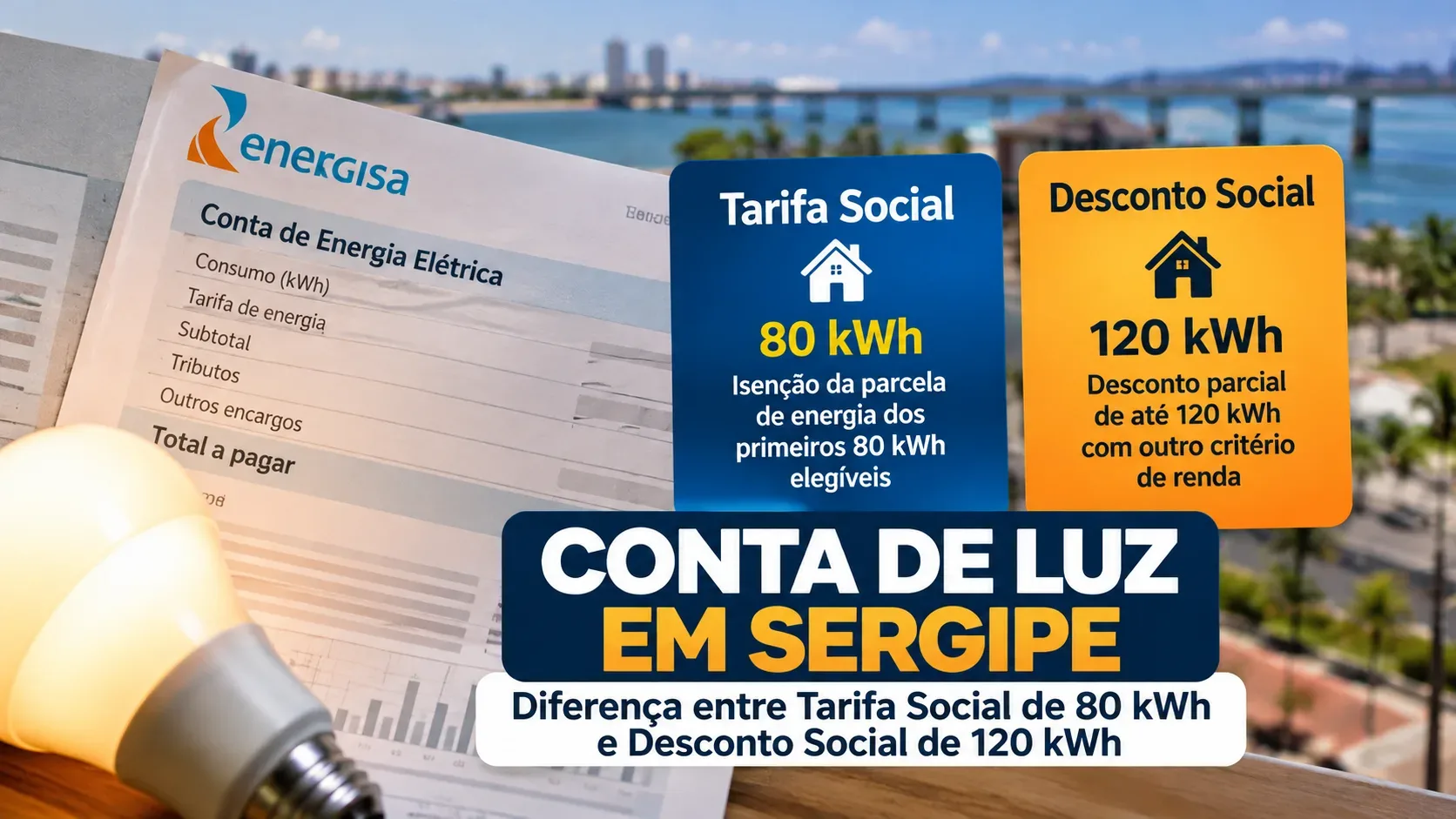
In Sergipe, Brazil, the Social Electricity Tariff exempts eligible households from the electricity tariff on the first 80 kWh consumed each month. The Social Discount, effective since January 1, 2026, instead removes one specific charge, the Energy Development Account (CDE), on consumption of up to 120 kWh. The two benefits have different eligibility criteria, and neither automatically means the entire bill will be zero.
The 80 kWh tariff exemption took effect on July 5, 2025. The Social Discount followed in the next phase of federal policy, established by Law 15,235/2025. The consumption thresholds define the portion covered by each rule, not a maximum amount of electricity households are allowed to consume.
Social Tariff versus Social Discount
| Criterion | Social Tariff | Social Discount |
|---|---|---|
| Main income requirement | CadÚnico registration and monthly income of up to half the minimum wage per person, plus specific legal exceptions | CadÚnico registration and monthly income above half and up to one minimum wage per person |
| What is reduced | 100% of the electricity tariff on the first 80 kWh of the month | The CDE sector charge on consumption of up to 120 kWh per month |
| Above the threshold | Electricity consumed above 80 kWh is charged | Consumption above 120 kWh does not qualify for the CDE exemption |
| How granted | Automatically once eligibility is identified and records match | Automatically once eligibility is identified and records match |
Income per person is calculated from household income and the number of family members. The Social Discount does not increase the free electricity allowance from 80 to 120 kWh. Each program follows its own rules; the benefits should not be added together as if they were two exemptions from the same charge.
Who qualifies for the 80 kWh Social Tariff?
The most common criterion is enrollment in Brazil's Single Registry for Social Programs (CadÚnico), with monthly income per person of no more than half the national minimum wage. People aged 65 or older and people with disabilities who receive the Continuous Cash Benefit (BPC) may also qualify.
Another eligible case involves a CadÚnico household with total monthly income of up to three minimum wages and a family member who continuously needs electrical equipment for medical treatment, subject to required medical documents. Indigenous and quilombola households registered in CadÚnico are also covered under the federal eligibility rules.
If an eligible household uses 100 kWh in a month, the tariff on the first 80 kWh is waived, while the 20 kWh above that limit is charged. Using more than 80 kWh does not automatically mean the household loses its benefit registration.
How does the Social Discount for up to 120 kWh work?
The Social Discount applies to households listed in CadÚnico whose monthly income per person is above half the minimum wage and no more than one minimum wage. Law 15,235/2025 exempts CDE charges for one electricity service account per household, applying to monthly consumption of up to 120 kWh.
CDE is only one component of an electricity bill. Customers therefore continue to pay the other tariff components and applicable charges. Any consumption above 120 kWh does not benefit from this discount. The program does not provide 120 kWh of entirely free electricity.
The amount saved depends on the tariff components used in each bill. A percentage cited in a news report or press statement should not be read as a fixed, universal discount on all bills.
Why can the bill still show an amount due?
Even if the Social Tariff fully waives the electricity portion of a month in which consumption is at or below 80 kWh, the bill may still include a municipal street-lighting contribution, taxes where applicable, installment payments, past-due balances or additional services. ANEEL and the Ministry of Mines and Energy explain that exemption from the electricity tariff is not the same as exemption from every charge.
With the Social Discount, electricity and other tariff components remain payable because the reduction specifically concerns the CDE. In either case, residents should review the itemized bill and pay amounts actually due.
How to verify the benefit and correct registration
- Check the bill for the benefit classification assigned to the service account and identify the electricity distributor listed on it.
- Make sure CadÚnico records are current. For the Social Tariff, ANEEL requires an update within the previous two years; changes in income, address or household membership should also be reported to the municipal CadÚnico office or the local Social Assistance Reference Center (CRAS).
- Verify that the account holder and service address match the household's registration. If the bill is in someone else's name or the benefit is missing, contact the distributor about the documents and matching of records.
- In Energisa's service area, the company lists official channels such as its Energisa On app and Digital Agency. Eligible households identified through the records receive the benefit automatically; customer support can address registration discrepancies.
The Ministry of Mines and Energy also recommends checking the bill, contacting the distributor or calling 121, the Ministry of Development and Social Assistance information line. Households do not need to pay an intermediary to register in CadÚnico.
Does Energisa serve every municipality in Sergipe?
No. According to the Sergipe regulatory agency Agrese, Energisa Sergipe serves 63 municipalities. Sulgipe supplies 12 municipalities in Sergipe: Arauá, Boquim, Cristinápolis, Estância, Indiaroba, Itabaianinha, Pedrinhas, Riachão do Dantas, Santa Luzia do Itanhy, Tobias Barreto, Tomar do Geru and Umbaúba. The permit holder Cercos serves villages in the Colônia Treze area of Lagarto.
Federal eligibility rules are not restricted to Energisa's concession. Residents should seek billing and registration help from the distributor or permit holder named on their bill, rather than assuming that customer service channels in Aracaju serve every locality.
Information validity
The rules and service areas were checked on October 26, 2026. Laws, registration status and tariffs may change, so households should check official notices and the current bill before making decisions about payment or registration.