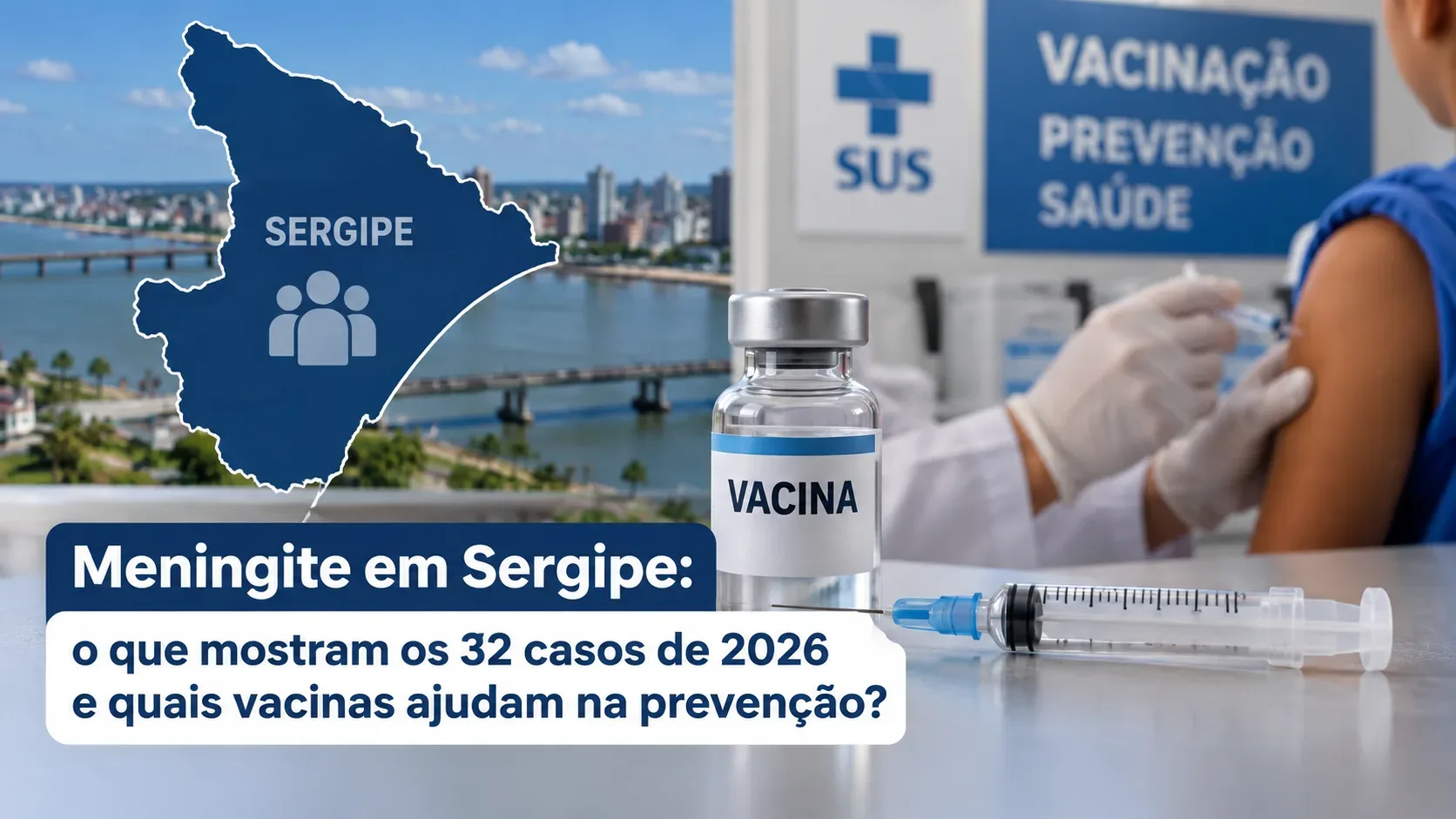
Sergipe recorded 32 meningitis cases in 2026 in figures accumulated through September, according to a report released by the Sergipe State Health Department (SES) on October 5. There were 15 cases of pneumococcal meningitis, two of meningococcal meningitis and 15 categorized by the department as other unspecified forms. That is the reporting period, not a case count updated to October 24. For prevention, Brazil's public health system (SUS) provides different vaccines that target specific pathogens and population groups under the national schedule.
The figures cover the state of Sergipe. The SES publication does not break down the 32 cases by municipality and, on its own, does not establish that a widespread outbreak is occurring. Nor does it rule out local situations being investigated.
What the 32 cases show, and what they do not
SES presented the figures based on records in Brazil's Notifiable Diseases Information System (Sinan). It also reported 205 meningitis cases between 2022 and September 2026, encompassing various causes of the disease. That total spans several years and must not be confused with the 32 cases recorded in 2026.
| Classification reported by SES | 2026 cases through September |
|---|---|
| Pneumococcal meningitis | 15 |
| Meningococcal meningitis | 2 |
| Other forms not specified in the statement | 15 |
| Reported total | 32 |
The breakdown matters because meningitis is not caused by a single microorganism. The aggregate figure alone does not reveal where transmission occurred, patients' ages, clinical outcomes or whether an outbreak has been confirmed. The October 5 statement does not provide those details for the 32 cases.
Meningitis has different causes, and vaccines depend on the cause
Meningitis is an inflammation of the membranes surrounding the brain and spinal cord. It can be caused by bacteria, viruses, fungi or parasites and, in some circumstances, by noninfectious conditions. Bacterial forms can progress rapidly and require urgent medical care. Identifying the pathogen requires clinical assessment and tests.
Vaccines included in the SUS program protect against some major causes of meningitis, particularly bacterial ones, but not every form. A meningococcal vaccine does not replace a pneumococcal vaccine or the five-in-one vaccine, and none provides universal protection against all meningitis.
Which SUS vaccines help prevent meningitis?
| Vaccine | Meningitis-related protection | Who should check eligibility |
|---|---|---|
| Meningococcal C | Invasive disease caused by meningococcal serogroup C. | Young children, following the routine schedule. |
| Meningococcal ACWY | Invasive disease caused by meningococcal serogroups A, C, W and Y. | Children receiving the scheduled dose at 12 months and adolescents according to age and immunization history. |
| Conjugate pneumococcal vaccines | Invasive pneumococcal disease, which can cause meningitis. The 2026 schedule includes 10-valent and 20-valent formulations. | Children and specially eligible groups, according to current rules. |
| Five-in-one (including Hib) | Haemophilus influenzae type b infections, including meningitis. | Infants under the childhood schedule. |
| BCG | Severe forms of tuberculosis, including tuberculous meningitis. | Newborns under the schedule. |
These vaccines cover different pathogens. It would be misleading to recommend all of them to everyone regardless of age, previous doses and health conditions. People with special medical needs may be evaluated within the Immunobiologics Network for People with Special Conditions, which includes reference centers (CRIE) and local health services.
The 2026 schedule: which ages matter?
- BCG: scheduled dose at birth.
- Five-in-one vaccine, which contains Hib: routine doses at 2, 4 and 6 months.
- Meningococcal C: doses at 3 and 5 months; at 12 months, the schedule calls for meningococcal ACWY.
- Meningococcal ACWY for adolescents: dose at age 11, with catch-up possible up to 14 years, 11 months and 29 days, depending on vaccination history.
- Conjugate pneumococcal vaccines: infant schedule starting at 2 months, with a booster at 12 months; the 2026 schedule lists 10-valent and 20-valent products at different stages.
The national schedule consulted on October 24, 2026 sets out routine vaccination. For late doses, a switch between pneumococcal formulations, higher-risk conditions or uncertainty over earlier shots, the vaccination team should review the immunization card and apply catch-up rules. A vaccine's inclusion in the national schedule does not prove it is in stock at any particular primary care unit in Aracaju or another municipality in Sergipe.
Which symptoms call for medical attention?
Fever, severe headache, a stiff neck, vomiting and sensitivity to light may occur in different forms of meningitis. Confusion, seizures, difficulty waking up and red or purplish skin spots are warning signs of severe illness. Babies may also show marked irritability, feeding difficulties, unusual sleepiness and a bulging soft spot on the head.
If meningitis is suspected, seek medical attention immediately. Do not wait for every symptom to appear, try to determine the cause yourself or delay assessment because the person has been vaccinated. Clinical management, tests and any treatment must be determined by healthcare professionals.
How to seek vaccination and reduce risks in Sergipe
The safest approach is to check the vaccination record and contact the municipal primary healthcare network to confirm the schedule appropriate for the person's age and vaccination history. Brazil's Ministry of Health says that not having the card does not prevent assessment and vaccination when indicated. Before traveling to a clinic, confirm service hours and dose availability with the healthcare provider in the person's own municipality; this article has not verified stocks at specific primary care units.
Alongside appropriate vaccination, the Ministry of Health recommends hand hygiene, well-ventilated spaces and respiratory etiquette when coughing or sneezing. These precautions complement, but do not replace, vaccination or medical assessment. The state figures presented here come from the report issued on October 5, 2026, covering records through September.
Sources and references
- Sergipe State Health Department, statement dated October 5, 2026
- Brazilian Ministry of Health, National Vaccination Schedule, accessed October 24, 2026
- Brazilian Ministry of Health, meningitis: causes, symptoms and prevention
- Brazilian Ministry of Health, vaccines for special-risk groups
- Brazilian Ministry of Health, general guidance on vaccination through SUS